Mobile App Security Compliance Guide: PCI DSS, HIPAA, GDPR, SOC 2, and More
Which security and privacy rules apply to your mobile app, and what do they actually require? A plain-language guide to PCI DSS, HIPAA, GDPR, SOC 2, India’s DPDP Act, and app store privacy rules.
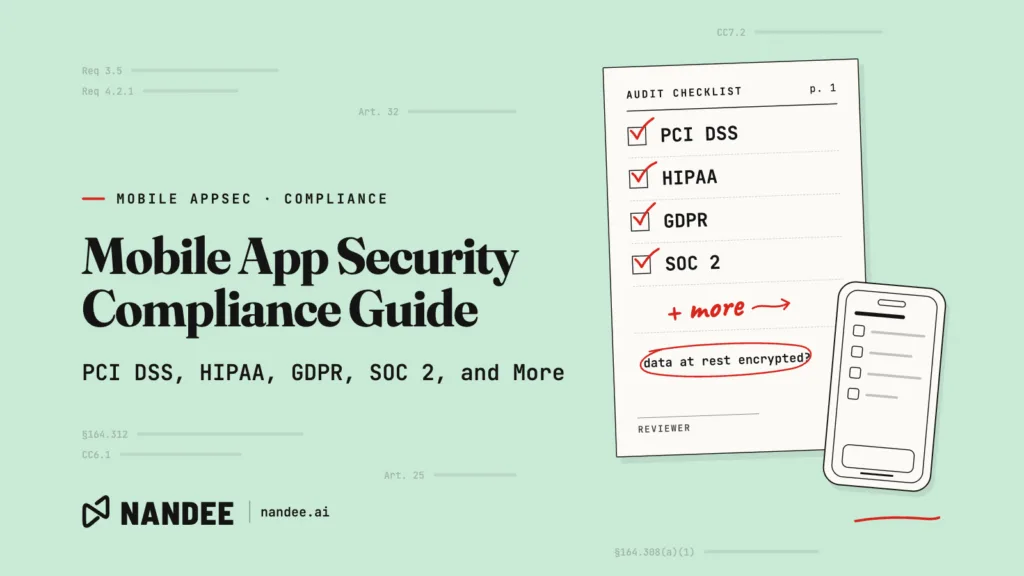
Sooner or later, every growing mobile app runs into a compliance question. A bank partner sends a security questionnaire. An enterprise customer asks for your SOC 2 report. A hospital wants to know how your app protects patient data. The questions are different, but they all come back to the same thing: can you show that your app handles sensitive data securely?
This guide explains which frameworks apply to which apps, what each one actually expects from a mobile app, and how to build one security program that covers most of them at once.
Quick answer: The frameworks that matter most for mobile apps are PCI DSS (payment card data), HIPAA (US health data), GDPR (personal data of people in the EU), SOC 2 (B2B trust), and regional privacy laws such as India’s DPDP Act and California’s CCPA. App stores add their own privacy disclosure rules. Most of them ask for the same core controls: encryption, access control, data minimization, secure development, testing, and the ability to prove it. OWASP MASVS is a practical way to map those requirements to your app.
This guide is general information, not legal advice. Work with qualified counsel and your auditor on your specific obligations.
Which frameworks apply to your app?
|
Framework |
Applies when your app… |
Region |
|
PCI DSS |
Stores, processes, or transmits payment card data, or can affect its security |
Global |
|
HIPAA |
Handles protected health information for a covered entity or as a business associate |
United States |
|
GDPR |
Processes personal data of people in the EU or EEA |
EU and EEA |
|
SOC 2 |
Is sold to businesses that want assurance about your security controls |
Mostly US, used globally |
|
DPDP Act |
Processes digital personal data of individuals in India |
India |
|
CCPA / CPRA |
Collects personal information of California residents and meets the law’s thresholds |
California |
|
App store privacy rules |
Is published on Google Play or the Apple App Store |
Global |
Many apps fall under several at once. A US fintech app with European users and enterprise customers may need PCI DSS, GDPR, and SOC 2 at the same time.
PCI DSS: payment apps
The Payment Card Industry Data Security Standard applies to any system that stores, processes, or transmits cardholder data. Version 4.0 replaced version 3.2.1, and its newer requirements became mandatory in 2025.
What it means for a mobile app:
•Keep card data out of the app wherever possible. Use a payment provider’s SDK or hosted fields so raw card numbers never touch your app or servers. This can shrink your PCI scope dramatically.
•Never store card numbers, CVVs, or PINs on the device.
•Encrypt all transmission with strong TLS and validate certificates.
•Follow secure development practices and test for vulnerabilities before release.
•Accepting payments on phones (tap to pay) falls under separate PCI standards for mobile payment acceptance, so check with your payment provider early.
Deeper dive: PCI DSS 4.0 Requirements for Mobile Payment Apps (coming soon).
HIPAA: health apps in the US
HIPAA’s Security Rule requires administrative, physical, and technical safeguards for electronic protected health information (ePHI). It applies to healthcare providers, health plans, and clearinghouses, and to the vendors that handle ePHI for them, known as business associates.
What it means for a mobile app:
•Encrypt ePHI at rest on the device and in transit.
•Control access with strong authentication, automatic session timeouts, and unique user identities.
•Log access to health data on the backend so you can audit who saw what.
•Keep ePHI out of push notifications, logs, analytics, and crash reports.
•Sign business associate agreements (BAAs) with any vendor that touches ePHI, including cloud and analytics providers.
Not every health or wellness app is covered by HIPAA. Consumer apps that are not working with covered entities may instead fall under consumer protection rules, such as the FTC’s Health Breach Notification Rule.
Deeper dive: HIPAA Compliance for Healthcare Mobile Apps (coming soon).
GDPR: personal data in the EU
The General Data Protection Regulation applies to any organization processing personal data of people in the EU, wherever the organization is based. Fines can reach 4% of global annual turnover or 20 million euros, whichever is higher.
What it means for a mobile app:
•Have a lawful basis for each type of data you collect, and get valid consent where consent is the basis.
•Collect the minimum data the feature needs.
•Build privacy in by design, including secure defaults and encryption.
•Control third-party SDKs. Analytics and ad SDKs often collect personal data as soon as they start. Initialize them only after consent where required.
•Support user rights such as access, correction, and deletion.
•Report qualifying breaches to the regulator within 72 hours.
Deeper dive: GDPR and Mobile Apps: Data Collection Pitfalls (coming soon).
SOC 2: selling to businesses
SOC 2 is not a law. It is an audit report, based on the AICPA’s Trust Services Criteria (security, availability, processing integrity, confidentiality, and privacy), that shows customers how you protect their data. A Type I report checks controls at a point in time. A Type II report checks that they worked over a period, usually 6 to 12 months.
What auditors usually ask mobile-first companies:
•How do you test your app for security issues, and how often?
•How are vulnerabilities tracked, prioritized, and fixed?
•Who can release a build, and how is the signing key protected?
•How do you manage third-party SDKs and dependencies?
•How is customer data encrypted on the device and in transit?
A repeatable mobile security testing process with records of findings and fixes is one of the easiest ways to answer these questions.
Deeper dive: SOC 2 for Mobile-First Startups: What Auditors Ask (coming soon).
India’s DPDP Act
India’s Digital Personal Data Protection Act, 2023 governs how organizations process digital personal data of individuals in India. Its rules phase in obligations over time, so check the current timelines with counsel.
What it means for a mobile app:
•Clear notice and consent in plain language before collecting personal data.
•Purpose limitation: use data only for the purpose you stated.
•Reasonable security safeguards to prevent personal data breaches.
•Breach notification to the Data Protection Board and affected users.
•Extra care for children’s data, including verifiable parental consent.
Deeper dive: India DPDP Act: What Mobile App Developers Must Know (coming soon).
App store privacy rules
Both major app stores now require privacy disclosures, and both review them.
•Google Play Data safety section: you must declare what data your app and its SDKs collect and share, and how it is protected.
•Apple privacy details and privacy manifests: you must disclose data collection in App Store Connect, and apps and SDKs must include a privacy manifest that explains their use of certain sensitive APIs.
These disclosures must match what your app actually does, including every SDK inside it. An inaccurate declaration can lead to rejection or removal.
Deeper dive: Google Play Data Safety Section: Getting It Right (coming soon).
One program, many frameworks
The good news is that these frameworks overlap heavily. Build your program around a common set of controls and map each framework to it.
|
Core control |
PCI DSS |
HIPAA |
GDPR |
SOC 2 |
DPDP |
|
Encrypt sensitive data at rest and in transit |
Yes |
Yes |
Yes |
Yes |
Yes |
|
Strong authentication and access control |
Yes |
Yes |
Yes |
Yes |
Yes |
|
Collect and keep only what you need |
Yes |
Yes |
Yes |
Yes |
Yes |
|
Secure development and regular security testing |
Yes |
Yes |
Yes |
Yes |
Yes |
|
Third-party and SDK risk management |
Yes |
Yes |
Yes |
Yes |
Yes |
|
Logging and incident response |
Yes |
Yes |
Yes |
Yes |
Yes |
|
User consent and privacy notices |
|
|
Yes |
Partly |
Yes |
OWASP MASVS turns these controls into concrete, testable requirements for mobile apps, which makes it a useful bridge between what auditors ask and what developers build. For a walkthrough of the risks behind them, see the OWASP Mobile Top 10 (2024) guide.A practical compliance roadmap
1.Map your data. List what personal, payment, and health data your app collects, where it is stored, and which SDKs receive it.
2.Identify your frameworks. Use the table above to see which apply, and confirm with counsel.
3.Reduce scope. Remove data you do not need and use providers that keep card data and other sensitive data out of your systems.
4.Adopt MASVS as your baseline. Use it to define your app’s security requirements.
5.Test every release. Run automated mobile security testing in CI and keep the reports.
6.Fix and document. Track findings to resolution. Auditors want to see the process, not just a clean result.
7.Review yearly. Laws, standards, and app store rules change. Revisit your mapping at least once a year.
FAQ
Does my mobile app need to be PCI compliant? If your app stores, processes, or transmits payment card data, yes. Using a payment provider’s SDK so card data never reaches your app or servers can greatly reduce your scope.
Are all health apps covered by HIPAA? No. HIPAA applies to covered entities and their business associates. A consumer wellness app may fall outside HIPAA but still be subject to other rules, such as the FTC’s Health Breach Notification Rule.
Is SOC 2 required by law? No. SOC 2 is a voluntary audit that many business customers require before they buy.
How does OWASP MASVS help with compliance? MASVS defines testable security controls for mobile apps. Mapping your compliance requirements to MASVS gives developers clear tasks and gives auditors clear evidence.
What evidence do auditors want for mobile app security? Typically: your security testing reports, how findings were prioritized and fixed, how releases and signing keys are controlled, and how third-party SDKs are reviewed.
Make compliance evidence part of every release
Nandee is an AI-assisted mobile application security testing platform for Android and iOS apps. It tests every build, maps findings to OWASP standards, and keeps a record of what was found and fixed for your audits and customer reviews.